Sustainability Performance Indicators
| Indicator | Unit | FY2023 | FY2024 | FY2025 |
|---|---|---|---|---|
| Economic | ||||
| Procurement | ||||
| Average Proportion spent on local suppliers | % | 52.22 | 58.07 | 58.19 |
| Average Proportion of local suppliers | % | 79.87 | 77.22 | 82.31 |
| Suppliers assessed for environmental impacts | % | 1.12 | 7.52 | 0.00 |
| Suppliers assessed for social impacts | % | 1.12 | 3.40 | 0.00 |
| Carbon Emission Intensity | ||||
| Division | ||||
| Agricultural Chemicals | tCO₂e/RM mil | N/A | 20.38 | 21.39 |
| Industrial Chemicals | tCO₂e/RM mil | N/A | 4.51 | 9.04 |
| Polymers | tCO₂e/RM mil | N/A | 61.32 | 68.30 |
| Logistics | tCO₂e/RM mil | N/A | 87.34 | 75.31 |
| Investment Holdings & Others | tCO₂e/RM mil | N/A | 16.38 | 17.90 |
| Total Carbon Emission | tCO₂e/RM mil | N/A | 189.93 | 191.94 |
| N/A as reporting began in FY2024. | ||||
| Corruption | ||||
| Employees receiving anti-corruption and anti-bribery training | Number | 331 | 310 | 634 |
| Board of Directors receiving anti-corruption and anti-bribery training | Number | N/A | 5 | 10 |
| Management employees receiving anti-corruption and anti-bribery training | Number | 96 | 65 | 175 |
| Non-management receiving anti-corruption and anti-bribery training | Number | 235 | 240 | 449 |
| Operations assessed for corruption-related risks | % | 5.26 | 8.33 | 55.56 |
| Confirmed incidents of corruption | Number | 0 | 0 | 0 |
| Employees disciplined or dismissed due to non-compliance with Anti-Bribery & Anti-Corruption Policy | Number | 0 | 0 | 0 |
| Cost of fines, penalties or settlements in relation to corruption | RM | 0 | 0 | 0 |
| Total political contributions | RM | 0 | 0 | 0 |
| Environment | ||||
| Energy | ||||
| Diesel | TJ | 171 | 132 | 172 |
| Natural Gas | TJ | 173 | 168 | 167 |
| Electricity | TJ | 50 | 56 | 59 |
| Others* | TJ | N/A | 4** | 5 |
| Total energy consumption | TJ | 394 | 360 | 403 |
| * Refers to a mixture of heavy fuel oil, marine oil, petrol and liquified petroleum gas (“LPG”). ** Data in FY2023 only include those of seven (7) Operating Companies. | ||||
| Water | ||||
| Municipal water consumption | m³ | 283,775 | 463,160 | 406,109 |
| The reported water consumption excludes activities carried out by third-party lessees who maintain operational control over the assets during the lease period. | ||||
| Waste and Effluents | ||||
| Total waste generated | Tonnes | 113,474 | 113,701 | 122,801 |
| Total waste diverted from disposal (recycled or repurposed) | Tonnes | 2,369 | 398 | 854 |
| Total waste directed to disposal (non-recycled) | Tonnes | 6,855 | N/A | 7,309 |
| Total scheduled waste | Tonnes | 2,369 | 398 | 854 |
| Effluent discharge | m³ | 85,707 | 135,461* | 104,264 |
| * FY2024 data restated following an updated baseline study. | ||||
| GHG Emissions | ||||
| Scope 1 | tCO₂e | 23,055.00 | 21,328.45 | 22,886.14 |
| Scope 2 | tCO₂e | 8,229.88 | 13,967.20 | 12,748.44 |
| Scope 3: Category 6 - Business Travel | tCO₂e | 149 | 61.16 | 352.86 |
| Scope 3: Category 13 - Leased Assets | tCO₂e | N/A | 3.7 | 4.21 |
| Total | tCO₂e | 31,433.88 | 35,360.51 | 35,991.65 |
| Electricity Consumption over Revenue | ||||
| Division | ||||
| Agricultural Chemicals | kWh/RM mil | 0.012 | 0.013 | 0.014 |
| Industrial Chemicals | kWh/RM mil | 0.002 | 0.003 | 0.003 |
| Polymers | kWh/RM mil | 0.047 | 0.049 | 0.051 |
| Logistics | kWh/RM mil | 0.004 | 0.005 | 0.004 |
| Investment Holdings & Others | kWh/RM mil | 0.024 | 0.025 | 0.028 |
| Total | kWh/RM mil | 0.089 | 0.095 | 0.100 |
| Water Consumption over Revenue | ||||
| Division | ||||
| Agricultural Chemicals | kWh/RM mil | 0.27 | 0.56 | 0.31 |
| Industrial Chemicals | kWh/RM mil | 0.08 | 0.11 | 0.16 |
| Polymers | kWh/RM mil | 0.22 | 0.23 | 0.28 |
| Logistics | kWh/RM mil | 0.06 | 0.16 | 0.22 |
| Investment Holdings & Others | kWh/RM mil | 0.15 | 0.16 | 0.51 |
| Total | kWh/RM mil | 0.78 | 1.22 | 1.48 |
| Conformance | ||||
| Total costs of environmental fines and penalties | RM | 12,000 | 200,000 | 100,000 |
| Social | ||||
| Diversity | ||||
| Total headcount | Number | 1,111 | 1,161 | 1,242 |
| Employees by gender | ||||
| Male | Number (%) | 800 (72.01) | 835 (71.92) | 871 (70.13) |
| Female | Number (%) | 311 (27.99) | 326 (28.08) | 371 (29.87) |
| Employees by age | ||||
| 18-25 years old | Number (%) | 121 (10.89) | 126 (10.85) | 117 (9.42) |
| 26-35 years old | Number (%) | 413 (37.17) | 441 (37.98) | 456 (36.71) |
| 36-45 years old | Number (%) | 266 (23.94) | 260 (22.39) | 295 (23.75) |
| 46-60 years old | Number (%) | 262 (23.58) | 284 (24.46) | 306 (24.64) |
| 60 years old > | Number (%) | 49 (4.41) | 50 (4.31) | 68 (5.48) |
| Employees by contract | ||||
| Full-time employees | Number (%) | 949 (85.42) | 1079 (92.94) | 1074 (86.47) |
| Contractors/Temporary employees | Number (%) | 162 (14.58) | 82 (7.06) | 168 (13.53) |
| Employees by Ethnicity | ||||
| Bumiputera | Number (%) | 632 (56.89) | 631 (54.35) | 687 (55.31) |
| Chinese | Number (%) | 168 (15.12) | 206 (17.74) | 240 (19.32) |
| Indian | Number (%) | 116 (10.44) | 117 (10.08) | 122 (9.82) |
| Foreigners | Number (%) | 195 (17.55) | 207 (17.83) | 193 (15.54) |
| Employees by Category | ||||
| Management | Number (%) | 203 (18.27) | 168 (14.47) | 226 (18.20) |
| Non-Management | Number (%) | 908 (81.73) | 993 (85.53) | 1016 (81.80) |
| Gender by Employee Category | ||||
| Management: Male | Number (%) | 115 (10.35) | 103 (8.87) | 137 (11.03) |
| Management: Female | Number (%) | 88 (7.92) | 65 (5.60) | 89 (7.17) |
| Non-Management: Male | Number (%) | 685 (61.66) | 734 (63.22) | 736 (59.26) |
| Non-Management: Female | Number (%) | 223 (20.07) | 259 (22.31) | 280 (22.54) |
| Age by Employee Category | ||||
| Management: 18-25 years old | Number (%) | 1 (0.09) | 2 (0.17) | 0 (0.00) |
| Management: 26-35 years old | Number (%) | 37 (3.33) | 17 (1.46) | 34 (2.74) |
| Management: 36-45 years old | Number (%) | 59 (5.31) | 40 (3.45) | 50 (4.03) |
| Management: 46-60 years old | Number (%) | 81 (7.29) | 80 (6.89) | 107 (8.62) |
| Management: 60 years old > | Number (%) | 25 (2.25) | 29 (2.50) | 35 (2.82) |
| Non-Management: 18-25 years old | Number (%) | 120 (10.80) | 124 (10.68) | 110 (8.86) |
| Non-Management: 26-35 years old | Number (%) | 376 (33.84) | 424 (36.52) | 430 (34.62) |
| Non-Management: 36-45 years old | Number (%) | 207 (18.63) | 215 (18.52) | 244 (19.65) |
| Non-Management: 46-60 years old | Number (%) | 181 (16.29) | 209 (18.00) | 201 (16.18) |
| Non-Management: 60 years old > | Number (%) | 24 (2.16) | 21 (1.81) | 31 (2.50) |
| Employees by qualification | ||||
| Degree | Number (%) | 269 (24.21) | 267 (23.00) | 404 (32.53) |
| Diploma | Number (%) | 158 (14.22) | 179 (15.42) | 160 (12.88) |
| Certificate/Others | Number (%) | 684 (61.57) | 626 (53.92) | 681 (54.83) |
| Disabilities | ||||
| Disabled staff | Number (%) | 1 (0.09) | 2 (0.17) | 2 (0.16) |
| Board of directors | ||||
| Total directors | Number | 8 | 8 | 10 |
| Directors by gender | ||||
| Male | Number (%) | 7 (87.50) | 7 (87.50) | 8 (80.00) |
| Female | Number (%) | 1 (12.50) | 1 (12.50) | 2 (20.00) |
| Directors by age | ||||
| 18-25 years old | Number (%) | 0 | 0 | 0 |
| 26-35 years old | Number (%) | 0 | 0 | 0 |
| 36-45 years old | Number (%) | 0 | 0 | 0 |
| 46-60 years old | Number (%) | 2 (25.00) | 1 (12.50) | 3 (30.00) |
| 60 years old > | Number (%) | 6 (75.00) | 7 (87.50) | 7 (70.00) |
| Employee turnover | ||||
| Total Employee turnover (ratio*) | Number (%) | 220 (19.80) | 139 (11.97) | 212 (17.07) |
| * Employee turnover / average number of employees x 100 | ||||
| Employee turnover by gender | ||||
| Female | Number (%) | 80 (7.20) | 40 (3.45) | 65 (5.23) |
| Male | Number (%) | 140 (12.60) | 99 (8.53) | 147 (11.84) |
| Employee turnover by age | ||||
| 18-25 years old | Number (%) | 74 (6.66) | 22 (1.89) | 36 (2.90) |
| 26-35 years old | Number (%) | 90 (8.10) | 65 (5.60) | 88 (7.09) |
| 36-45 years old | Number (%) | 37 (3.33) | 29 (2.50) | 52 (4.19) |
| 46-60 years old | Number (%) | 13 (1.17) | 13 (1.12) | 27 (2.17) |
| 60 years old > | Number (%) | 6 (0.54) | 10 (0.86) | 9 (0.72) |
| Employee turnover by employee category | ||||
| Management | Number (%) | 7 (0.63) | 13 (1.12) | 36 (2.90) |
| Non-Management | Number (%) | 213 (19.17) | 126 (10.85) | 176 (14.17) |
| Voluntary/involuntary turnover | ||||
| Voluntary turnover | Number (%) | 213 (19.17) | 138 (11.89) | 188 (15.14) |
| Involuntary turnover | Number (%) | 7 (0.63) | 1 (0.09) | 24 (1.93) |
| Training and Development | ||||
| Total training time | Hours | 14,538 | 7,875 | 10,176 |
| Total training for Management | Hours | 5,949 | 3,855 | 1,841 |
| Total training for Non-Management | Hours | 8,589 | 4,020 | 8,335 |
| Total employees trained | Number | 870 | 807 | 1,142 |
| Health and safety | ||||
| Fatalities | Number | 0 | 0 | 0 |
| Employees trained on health and safety standards | Number | 376 | 294 | 561 |
| Lost time incident rate | Rate * | 1.38 | 0.02 | 0.70 |
| Subsidiaries with OSHAS 18001/ISO 45001 | Company | ALB | ALB | ALB |
| * Number of lost time injuries in the reporting period / Total number of hours worked in the reporting period * 200,000 | ||||
| Community | ||||
| Total amount invested in the community where the target beneficiaries are external to the listed issuer | RM | 238,294 | 549,476 | 824,433 |
| Human rights | ||||
| Substantiated complaints concerning human rights violations | Number | 0 | 0 | 0 |
| Customer Privacy | ||||
| Substantiated complaints concerning breaches of customer privacy and losses of customer data | Number | 0 | 0 | 0 |
MAIN TARGETS
Ancom Nylex Berhad Group and its subsidiaries aim to reduce its Greenhouse Gas (GHG) emissions by 3% by 2030.
| Pillar | KPI (Metric) | FY2025 Baseline | Target (by FY2030) | Standards |
|---|---|---|---|---|
| Environment | GHG Emissions Intensity (tCO2e / RM Million Revenue) | 191.94 | 3% Cumulative Reduction | IFRS S2, Malaysia New Industrial Master Plan (“NIMP”) 2030, National Energy Transition Roadmap (“NETR”) |
| Environment | Water Intensity (litres / RM Million Revenue) | 1.47 | 3% Cumulative Reduction | Water Sector Transformation Agenda 2040 (“WST2040”) |
| Environment | Electricity Intensity (kWh / RM Million Revenue) | 0.1 | 3% Cumulative Reduction | IFRS S2, Malaysia New Industrial Master Plan (“NIMP”) 2030, National Energy Transition Roadmap (“NETR”) |
| Environment | Total Waste Generated (Tonnes) | 122.081 | 3% Cumulative Reduction | National Solid Waste Management Policy (“NSWMP”), 12th Malaysia Plan (“12MP”) |
| Social | Lost Time Incident Rate (LTIR) (per 200,000 man-hours) | 0.7 | < 1 | OSHA (Occupational Safety and Health Administration) |
| Social | Supplier Compliance Rate (via ESG self-assessment) | 49% [FY2026] | Achieve 70% | Supplier Code of Conduct, GRI 308 & 414 |
| Governance | Board Gender Diversity (%) | 20% | 30% | Malaysian Code on Corporate Governance (MCCG), Bursa Listing Requirements |
Definitions & Benchmarks: (1) LTIR: Lost Time Incident Rate is calculated per 200,000 man-hours. A target of <1.0 is aligned with OSHA world-class safety benchmarks. (2) Baselines: FY2025 serves as the base year for all environmental metrics to track progress toward 2030 goals.
EXTERNAL VALIDATION
EcoVadis
In October 2025, Ancom Crop Care, a subsidiary of Ancom Nylex Berhad, achieved a score of 55/100 from EcoVadis. This globally recognized platform evaluates corporate sustainability across four key pillars: Environmental Impact, Labour and Human Rights, Ethics, and Sustainable Procurement.
Independent Assurance
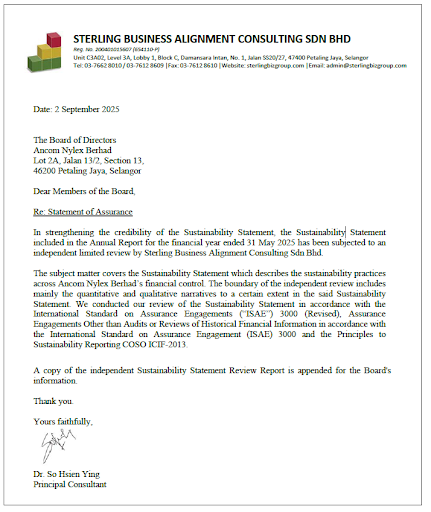
Ancom Nylex Berhad engaged Sterling Business Alignment Consulting Sdn Bhd to provide independent limited assurance on its 2025 Sustainability Report. The engagement focused on selected environmental, social, and governance (ESG) Key Performance Indicators (KPIs) and non-financial disclosures. This process was conducted in accordance with the International Standard on Assurance Engagements (ISAE) 3000 (Revised) to ensure data integrity and transparency.